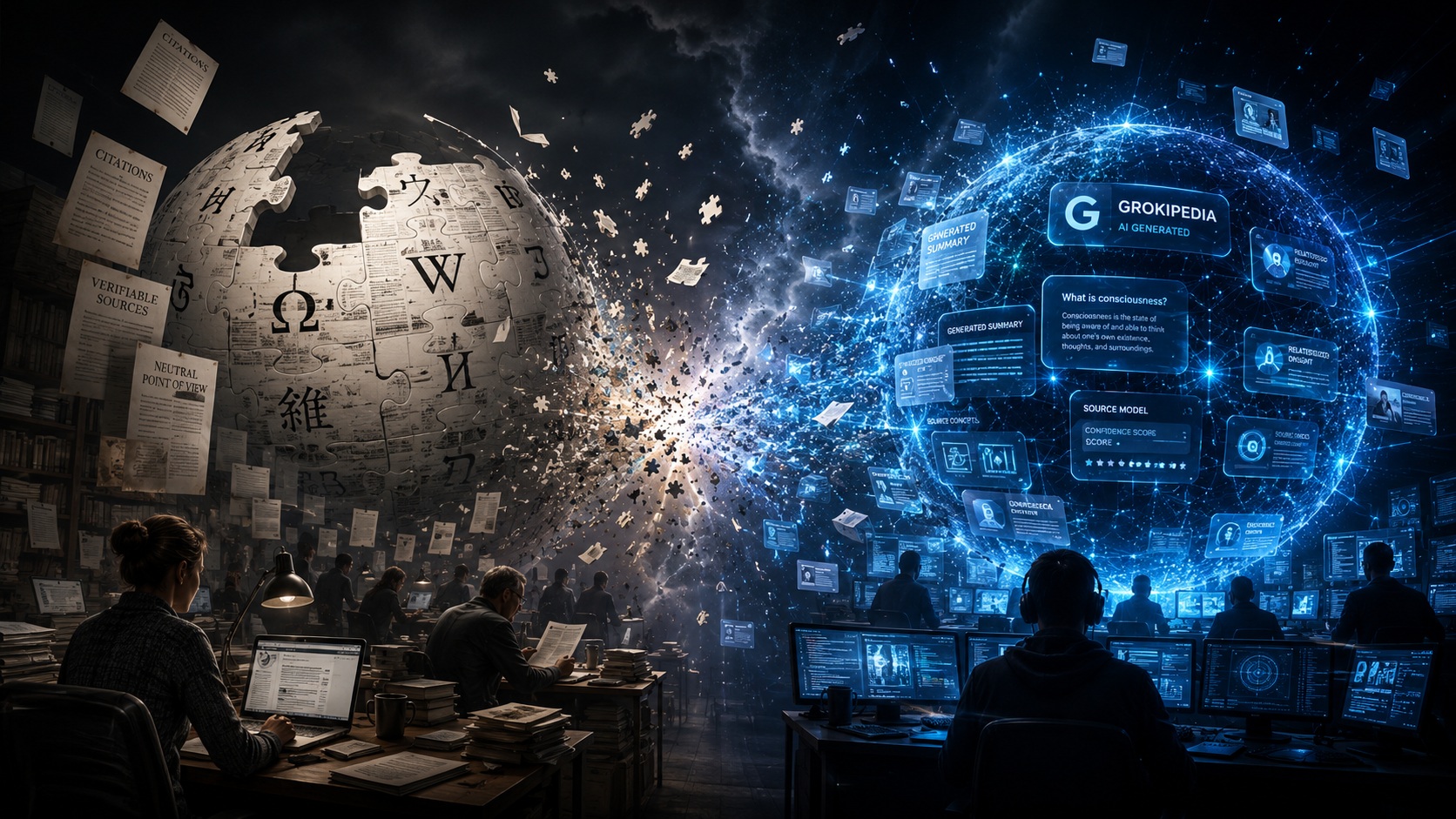
Grokipedia vs Wikipedia: When AI Starts Generating Truth
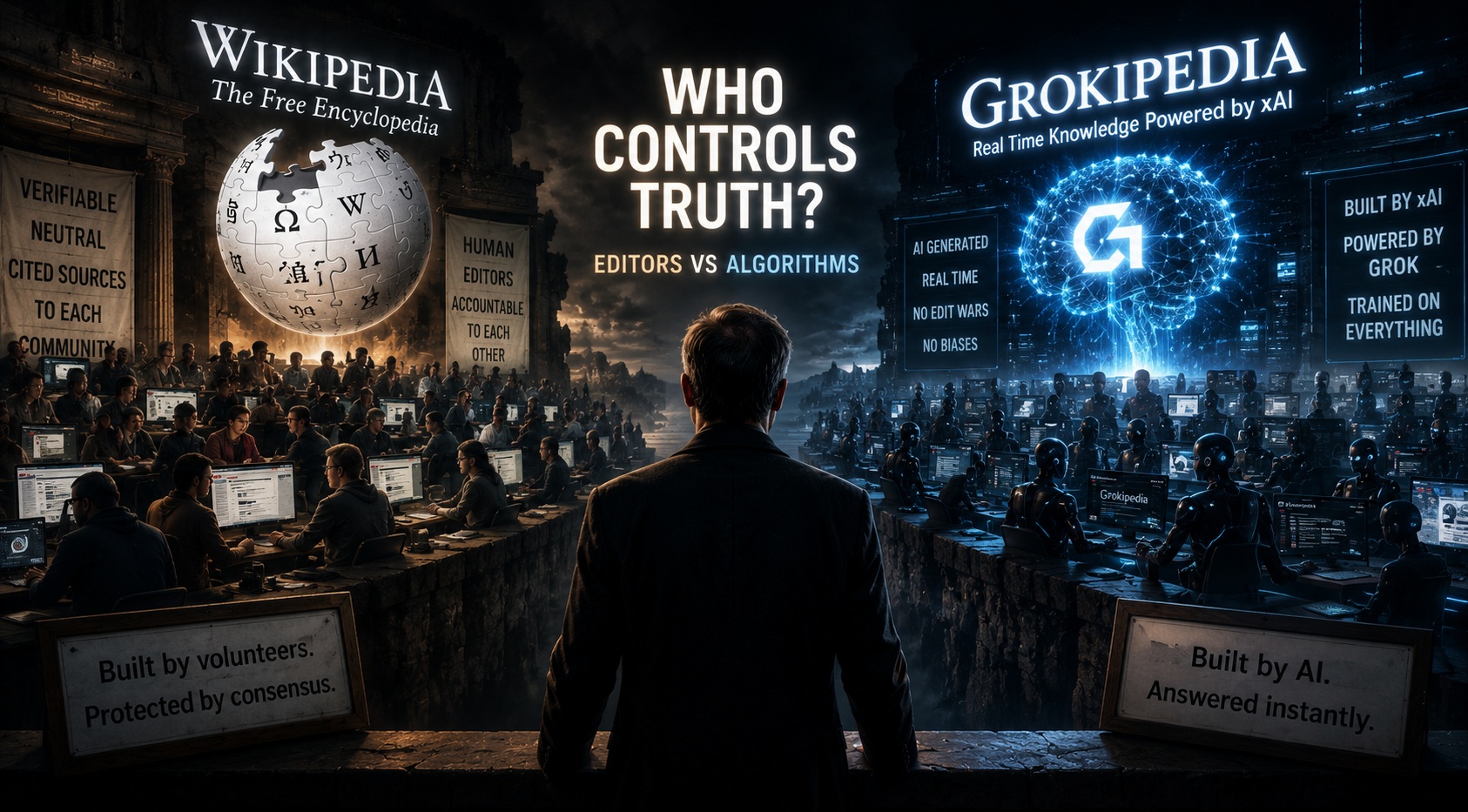
Grokipedia vs Wikipedia is not just a fight between two encyclopedia websites. It is a preview of the next internet war: human-edited consensus against AI-generated reality, volunteer citation culture against machine-produced authority, and the old question of who controls knowledge replaced by a colder one — which system gets to generate truth first?
WHEN THE ENCYCLOPEDIA WAR BECOMES A TRUTH WAR
Grokipedia vs Wikipedia exposes one of the most important power shifts happening online: the internet is moving from human-edited knowledge to machine-generated authority.
For more than two decades, Wikipedia has been the default public memory machine. Students used it. Journalists used it. Search engines surfaced it. AI systems trained on it. Ordinary people treated it as the first stop for understanding almost anything.
Wikipedia was never perfect. It had bias accusations, editor wars, ideological fights, anonymous power struggles, sourcing battles, personality conflicts, and endless procedural drama. But the core model was still human: editors argued, cited sources, reverted each other, fought over neutrality, and tried to force knowledge through a public process.
Grokipedia changes the fight.
It does not simply ask whether Wikipedia is biased. It asks whether human editing itself is obsolete. It asks whether the future encyclopedia should be written by volunteers at all, or generated by an AI system that claims it can process reality faster, cleaner, and with fewer human bottlenecks.
That is where the ethical danger begins.
TABLE OF CONTENTS
- Why Grokipedia matters
- Wikipedia’s human-edited reality machine
- Grokipedia’s AI-generated authority model
- Why this is bigger than Elon Musk
- The danger of machine-generated truth
- Editor breakdown
WHY GROKIPEDIA MATTERS
Grokipedia matters because it arrives at the exact moment public trust in information systems is already cracked.
People do not trust legacy media. They do not trust social platforms. They do not trust search results. They do not trust fact-checkers. They do not trust institutions. They do not even agree on what counts as a reliable source anymore.
Into that vacuum comes the promise of AI knowledge: instant, confident, cleanly formatted, endlessly scalable, and emotionally satisfying because it feels like an answer instead of a debate.
That is the seduction.
Wikipedia shows you the scars of human disagreement. Grokipedia promises to smooth those scars into a finished product.
Wikipedia is messy because people are messy. Grokipedia is dangerous because machines can hide the mess.
WIKIPEDIA’S HUMAN-EDITED REALITY MACHINE
Wikipedia’s model is built on a strange bargain: truth is not handed down from one authority, but assembled through conflict.
Editors fight over wording. They fight over sources. They fight over neutrality. They fight over whether a claim is due, undue, reliable, fringe, primary, secondary, promotional, defamatory, or politically loaded.
That process can be maddening. It can be bureaucratic. It can be unfair. It can reward insiders who know the rules better than outsiders who know the facts.
But it has one huge advantage: the conflict is visible.
You can inspect edit histories. You can read talk pages. You can watch reversions. You can see disputes. You can trace how a sentence became a sentence.
Wikipedia’s weakness is that it is full of human politics.
Wikipedia’s strength is that the politics leave fingerprints.
GROKIPEDIA’S AI-GENERATED AUTHORITY MODEL
Grokipedia flips the model.
Instead of a giant public fight among editors, it offers AI-generated encyclopedia entries produced through a centralized machine system. The pitch is speed, scale, and correction of alleged ideological bias inside Wikipedia.
That sounds powerful. It also creates a new problem.
When an AI system writes an encyclopedia entry, where exactly does the judgment happen?
Inside the training data?
Inside the prompt?
Inside the model weights?
Inside the company’s political assumptions?
Inside the invisible ranking of sources?
That is the real issue. AI does not remove editorial power. It relocates editorial power into systems most readers cannot see.
Wikipedia makes human bias visible through arguments. Grokipedia risks making machine bias feel neutral because it arrives as a finished answer.
WHY THIS IS BIGGER THAN ELON MUSK
It is easy to make this story only about Elon Musk.
That would be a mistake.
Musk is the accelerant, the brand, the chaos engine, the public avatar of the fight. But the deeper conflict would exist even without him.
The real issue is that AI-generated knowledge systems are coming for the role Wikipedia used to dominate. Search engines are already becoming answer engines. Chatbots already summarize topics before users ever click a source. AI assistants increasingly mediate what people see, believe, remember, and repeat.
That means the encyclopedia is no longer just a website.
The encyclopedia is becoming an interface.
The person who controls that interface does not merely organize information. They shape the first draft of public reality.
THE DANGER OF MACHINE-GENERATED TRUTH
The danger of Grokipedia is not that Wikipedia is perfect and Grokipedia is evil.
Wikipedia is not perfect. It has real flaws. Its internal culture can be hostile, ideological, opaque, and exhausting. Its highest-stakes pages often become battlegrounds where neutral language hides political warfare underneath the carpet.
But replacing human conflict with AI generation does not magically create truth.
It creates a different kind of authority problem.
- Who chooses the sources the AI trusts?
- Who decides which claims deserve emphasis?
- Who audits the model’s political framing?
- Who corrects hallucinated or distorted claims?
- Who explains why the machine wrote one version of reality instead of another?
These are not technical details. These are civilization-level editorial questions.
Because once AI-generated encyclopedia entries become normalized, truth can be manufactured at scale with the emotional confidence of objectivity.
No messy talk page. No visible edit war. No obvious fingerprints.
Just the answer.
THE OLD QUESTION WAS WHO EDITS TRUTH
The old internet knowledge war was about editors.
Who gets to edit the page?
Who gets reverted?
Which sources are reliable?
Which viewpoint is neutral?
Who wins the talk-page war?
That was already messy enough.
But the new question is colder:
Which machine generates truth?
That question is more dangerous because machines do not look like editors. They look like infrastructure. They look like search. They look like convenience. They look like neutrality because they do not sweat, argue, insult each other, or leave angry comments on talk pages.
But the power is still there.
It is just hidden behind the interface.
THE KNOWLEDGE WAR HAS ALREADY STARTED
Grokipedia vs Wikipedia is not a side drama in tech culture. It is a preview.
Every major AI company wants to become the layer between people and reality. Every search platform wants to answer before you click. Every chatbot wants to compress the internet into a paragraph. Every political faction wants its own version of “neutral.”
That means the future of knowledge may not be one encyclopedia replacing another.
It may be a thousand competing reality engines, each generating its own version of the world, each claiming to correct the bias of the others.
Wikipedia gave us edit wars.
AI may give us reality wars.
EDITOR BREAKDOWN
The Grokipedia vs Wikipedia fight matters because it reveals the next stage of information collapse.
The issue is not whether Wikipedia is pure. It is not. The issue is not whether AI can summarize information. It can. The issue is what happens when public knowledge moves from visible human dispute to invisible machine generation.
Wikipedia’s problem is that human editors fight over reality.
Grokipedia’s problem is that AI can generate reality without showing the fight.
That is the terrifying upgrade.
The old encyclopedia model forced users to trust a messy human process. The new model asks users to trust a machine-owned pipeline of source selection, framing, summarization, and correction.
And once truth becomes something generated instantly by competing systems, the public no longer asks, “What happened?”
They ask the machine they already trust.
That is the new knowledge war.
Not just Wikipedia against Grokipedia.
Human consensus against machine authority.
Visible argument against invisible generation.
The edit button against the answer box.
TOP 5 KNOWLEDGE FAILURES EXPOSED BY GROKIPEDIA VS WIKIPEDIA
| # | Failure | Why It Matters |
|---|---|---|
| 1 | Machine-generated authority | AI does not remove editorial judgment. It hides it inside systems most users cannot inspect. |
| 2 | Invisible source selection | The public may never know why one source, frame, or claim was prioritized over another. |
| 3 | False neutrality | Generated text can feel objective simply because it is polished, confident, and machine-produced. |
| 4 | Collapse of visible dispute | Wikipedia’s fights are messy but traceable; AI-generated entries can hide the conflict behind the answer. |
| 5 | Reality engine competition | The future may not be one shared encyclopedia, but many competing systems generating rival versions of truth. |
EDITOR’S NOTE
This article is commentary and opinion focused on Grokipedia, Wikipedia, AI-generated knowledge, online encyclopedia governance, source authority, algorithmic bias, human editing, machine-generated truth, and the future of public information systems. Grokipedia is presented here as part of a broader shift from human-edited knowledge platforms toward AI-mediated reality engines.
“`